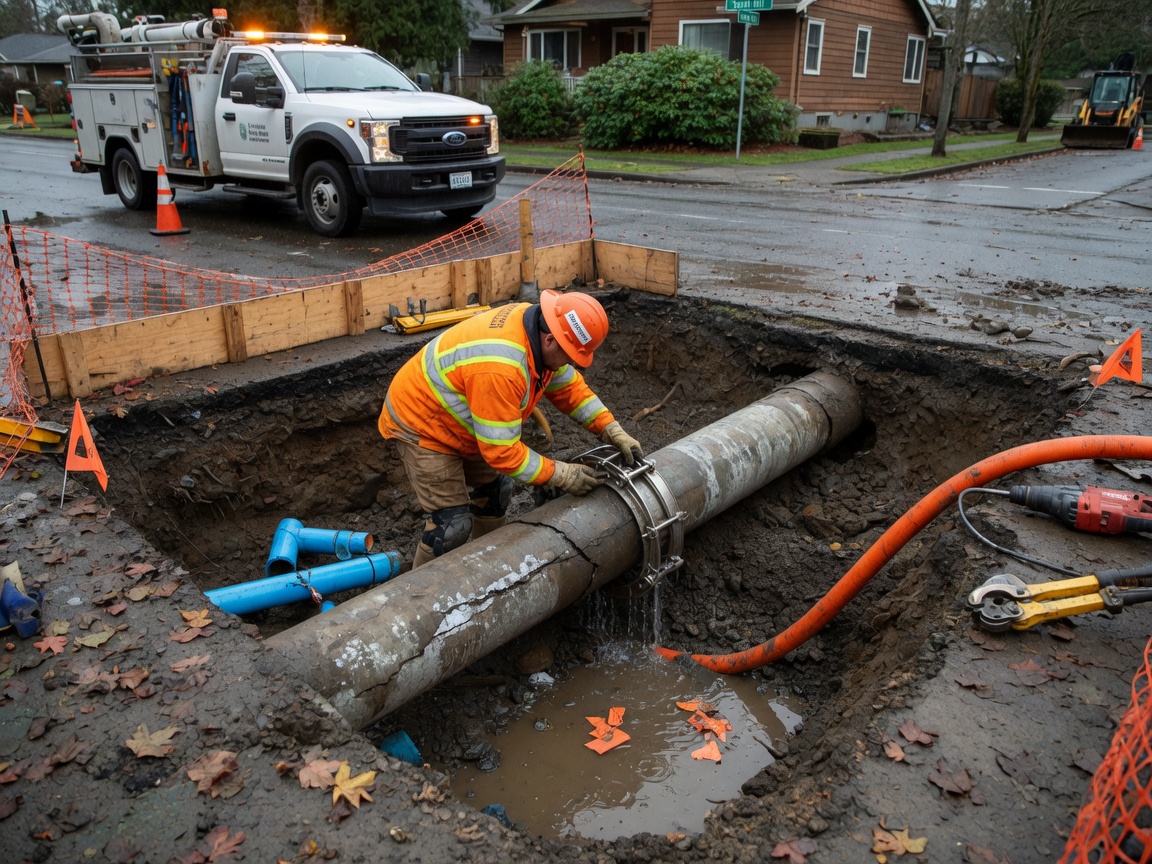
Puyallup's mild oceanic climate brings frequent rain that saturates clay-heavy soils along the Puyallup River and in the Valley, causing ground shifts that stress older galvanized and copper lines. Homes built before 1970 in Downtown Puyallup and near the Fairgrounds often have shallow service lines that crack when winter saturation combines with root intrusion from mature landscaping. Technicians here routinely encounter bellied or corroded sections where the line crosses property boundaries, requiring precise excavation to avoid damaging nearby sewer laterals that run parallel in many South Hill lots.
Repair decisions depend on whether the break is on the customer side or the Pierce County utility side of the meter. In Summit and South Hill neighborhoods, steep driveways and mature trees limit equipment access, so crews often combine camera inspection with small-machine digging to limit lawn damage. Polyethylene replacement pipe is commonly chosen over copper in these wet conditions because it flexes with ongoing soil movement without developing new pinhole leaks within a few seasons.
Code compliance in Puyallup requires permits and backflow prevention checks whenever a line is replaced, especially on properties close to the river where groundwater infiltration risks are higher. Homeowners in Sumner and Bonney Lake who call for the same service frequently discover that their lines were installed with improper bedding material, which accelerates future breaks during heavy spring rains. Proper compaction and tracer wire installation during repair prevents repeat visits and satisfies local inspectors on the first pass.
Technician insight
In Puyallup the thing that catches most people out with broken water line repair is how quickly the frequent rain turns clay soil into a shifting mess around older galvanized lines in the Valley and near the Puyallup River, so a small leak discovered in summer often becomes a full break by late fall if the bedding was never compacted right.
Valley Home After Heavy Rain
A homeowner in the Valley noticed reduced pressure after several days of rain. Camera inspection found a cracked galvanized line where soil had settled near the Puyallup River bank. The crew replaced the section with polyethylene, added proper bedding, and restored flow the same day.
Broken Water Line Repair Services We Offer
✓Trenchless Water Line Replacement
Pulls new polyethylene pipe through the old line path with minimal digging, ideal for South Hill properties where mature trees and steep slopes make open trenches costly.
✓Emergency Water Line Shutoff and Repair
Provides same-day response for active breaks in Downtown Puyallup and Valley neighborhoods, isolating the leak and restoring water while permanent repair is planned.
✓Galvanized Pipe Section Replacement
Removes corroded galvanized segments common in pre-1970 homes near the Puyallup Fairgrounds and installs new copper or PEX with proper dielectric unions.
✓Camera Inspection and Leak Location
Uses sewer camera equipment to trace breaks under driveways and lawns in Summit and South Hill without unnecessary excavation in rain-softened soil.
✓Service Line Tie-In to Main
Coordinates with the utility to replace the line from meter to curb stop in Pierce County, including permit handling and compaction to prevent future settling.
Broken Water Line Repair Cost in Puyallup, WA
| Service | Typical Range | What Affects It |
|---|---|---|
| Camera inspection and leak location | $275–$450 | Higher when access is limited by driveways in South Hill |
| Sectional galvanized replacement | $1,400–$2,900 | Varies with length and depth in older Downtown Puyallup homes |
| Trenchless full line pull | $3,200–$5,800 | Lower cost when the existing pipe path is straight and clear |
| Meter to curb stop tie-in | $2,100–$4,100 | Includes permit and utility coordination in Pierce County |
Ranges are typical for Puyallup, WA and confirmed with an exact written quote before any work starts.
How it works
- 1
Initial Assessment
Technician arrives during posted hours, reviews the leak symptoms, and checks meter and shutoff locations on the property.
- 2
Camera Location
Camera is run from the nearest cleanout to pinpoint the break while noting soil conditions and nearby utilities.
- 3
Excavation And Repair
Targeted digging removes the damaged section; new pipe is installed with proper bedding and tracer wire.
- 4
Backfill And Test
Trench is compacted in layers, water is restored, and the line is pressure tested before final restoration.
Pricing
Upfront written quotes after inspection; final price depends on depth, access, and whether the break is on private property or requires utility coordination.